During my years as a counsellor in a large high school, my team always kept the counselling office open during the lunch break to provide some of our more vulnerable students with a quieter space to eat lunch. (As an introvert who also longed for quiet spaces in the noisy building, I assumed this was what we were providing, a place to recharge and regulate.) The space was small, just eight chairs around a coffee table, but it was always full. The students who gathered here rarely interacted with one another; rather, they looked at their phones or laptops or books, quietly isolated each in their own private bubbles.
For years I interpreted those silent lunch breaks as a success, evidence that we had provided a safe and welcoming space for students who needed a break from the noise and the social demands of a busy school environment. It wasn’t until classes resumed after the COVID-19 health measures were lifted that I began to wonder what was really going on in this space. I was becoming increasingly aware of the ways in which loneliness and disconnection were impacting kids on my caseload, and I started to wonder if I had interpreted my ‘safe and quiet space’ inaccurately. Had I actually just provided another place where young people could withdraw because connecting with others felt so difficult and exhausting? Was I enabling further disconnection?
Canadian research suggests I was not alone in asking myself this question. In their knowledge synthesis of more than 200 Canadian publications on loneliness and belonging, Falkenberg and Heringer (2024) report that approximately one-third of Canadian adolescents experience loneliness at school. They also found that loneliness and a lack of belonging are associated with anxiety, depression, bullying, substance use, school avoidance, and poorer school success, all of which fall within a school counsellor’s area of concern. Reading this report set off some alarm bells.

It isn’t that I expect adolescents, or adults for that matter, not to experience occasional loneliness. As we know, there is an inevitable element of aloneness embedded in the human condition (Yalom, 1980). During adolescence, however, questions of identity, friendship, and belonging become increasingly important as young people develop a stronger sense of who they are and where they fit (Steinberg, 2023). A counsellor’s goal is not to eliminate every experience of loneliness; loneliness can prompt self-reflection, growth, and some fabulous angsty poetry! The concern arises when students become stuck there and disconnection begins to shape how they experience school, relationships, and themselves. In reflecting on my work with young people experiencing loneliness, I recognize that I spent significant time normalizing those feelings and supporting teens in managing them. Now I wonder if I dedicated enough time to finding ways to actively cultivate belonging within my school community.
Falkenberg and Heringer (2024) define belonging as the experience of having, and being able to maintain, meaningful interpersonal relationships. This understanding is consistent with Self-Determination Theory. Ryan and Deci (2000) identify relatedness as one of three basic psychological needs, alongside autonomy and competence. Relatedness reflects our need to feel connected to others, to experience caring relationships, and to know that we matter within a community. When this need is supported, it contributes to psychological wellbeing and healthy development. This shift in perspective has practical implications for school counsellors. If belonging develops through relationships and opportunities for meaningful participation, then fostering belonging cannot be left to chance. It requires intentional action. Falkenberg and Heringer (2024) provide several concrete suggestions for improving students’ sense of belonging within school communities.
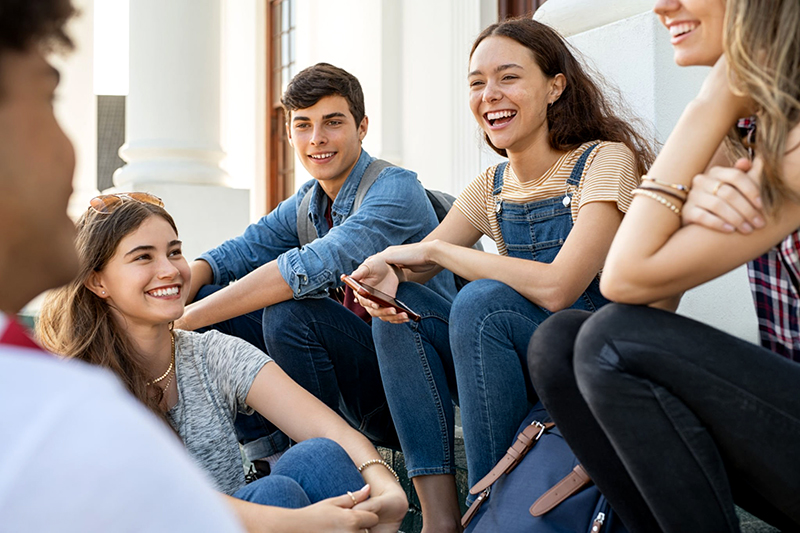
Structured connection. One implication of the research is that we can be more intentional about creating the conditions in which connection might occur. Simply bringing young people into the same physical space leaves a great deal to chance. Falkenberg and Heringer (2024) identified practices such as peer mentoring, buddy systems, welcoming activities for new students, extracurricular opportunities, and organized lunch groups designed to bring students together. One study in their review found that newcomer students who participated in organized lunches with a small group of Canadian-born peers reported that the experience reduced their loneliness.
Deliberately building supportive relationships. School counsellors already understand the importance of relationships, but the research gives us reason to think about how intentionally we build networks of supportive relationships around students. Caring and meaningful relationships with adults, characterized by trust and acceptance, are strongly associated with students’ sense of belonging (Falkenberg & Heringer, 2024). Regular opportunities for contact, individual time with trusted adults, peer mentoring, and relationships with families and students’ sociocultural communities all appear in the literature as practices that support connection. For some students, the counsellor may be one of those important relationships, but we are also well positioned to help widen the circle by connecting a student with a teacher, coach, peer, mentor, or other adult who can become another reliable point of connection.
Voice, choice, and contribution. Belonging also grows when young people experience themselves as participants in the life of their school. Student voice and agency, including having a meaningful say in their education and school community, are associated with a stronger sense of belonging (Falkenberg & Heringer, 2024). The practices identified in the research are quite concrete: asking students what belonging means to them, learning about their interests, identifying and highlighting their strengths, creating opportunities for them to contribute, and bringing their interests and stories into school life. This gives school counsellors something more purposeful to consider than simply finding an activity for a lonely student to join. We can help young people find places where their presence makes a difference. There is an important distinction between being included and feeling that one has something of value to contribute.
Measuring connection. We can also become more systematic about understanding students’ relational worlds. One practice described by Falkenberg and Heringer (2024) involves relationship mapping. In this activity, students confidentially identify several classmates with whom they would like to work, and those responses are used to create a sociogram showing patterns of connection within a classroom. The resulting map can reveal students who are rarely selected by peers, as well as groups of students whose relationships remain relatively closed. Repeating the exercise over time makes it possible to see how those patterns change. For school counsellors, the larger idea may be even more useful than the particular tool. We can gather information about connection with the same intentionality that we bring to attendance, academic progress, or other indicators of student wellbeing. A student can appear socially comfortable in the hallway and still have very few meaningful connections. Asking students about their relationships, and finding thoughtful ways to map those relationships, may reveal experiences that are easy for adults to miss.
Addressing structural barriers. Finally, cultivating belonging requires us to look beyond the individual student and consider the school environment in which connection is supposed to happen. Falkenberg and Heringer’s (2024) synthesis identifies racism, bullying, victimization, lack of representation, inequity, and barriers to inclusion as structural factors that shape students’ experiences of belonging. Representation within the curriculum and school community, inclusive language, cultural safety, equitable treatment, student voice, and meaningful family and community involvement are among the conditions associated with stronger belonging. This is where the advocacy role of the school counsellor becomes particularly important. When a young person is struggling to belong, our work always includes the student, but it may also involve conversations with teachers, administrators, families, and the wider school community about the conditions surrounding them. Sometimes we need to be brave enough to ask what needs to change in our school communities to make them more welcoming to those who do not feel they belong.
When I think back on those post-pandemic, quiet lunch hours in the counselling office, I see that room differently than I did at the time. It is still true that some of those students may simply have needed the quiet, just as I sometimes did. Others, however, may have been looking for connection without quite knowing how to find it. When I remember that room full of quiet students, I now see a room filled with questions that I am still learning to ask myself and my colleagues. Who is feeling lonely and isolated in this shared space? Who just needs a quiet place to take a breath? How can I know the difference?… And, as I learn to recognize the difference, how can I help? What is my role in supporting those individual connections, and how might I advocate for systemic change within my school community to foster more connection and belonging?
Ultimately, an essential part of our work is to help young people manage the inevitable and occasional experiences of loneliness in their lives, while actively building school communities in which they have genuine opportunities to belong.
THE AUTHOR:
Lisa Porter, CCC, former school counsellor, current Associate Director at City University M.Ed. School Counselling program